

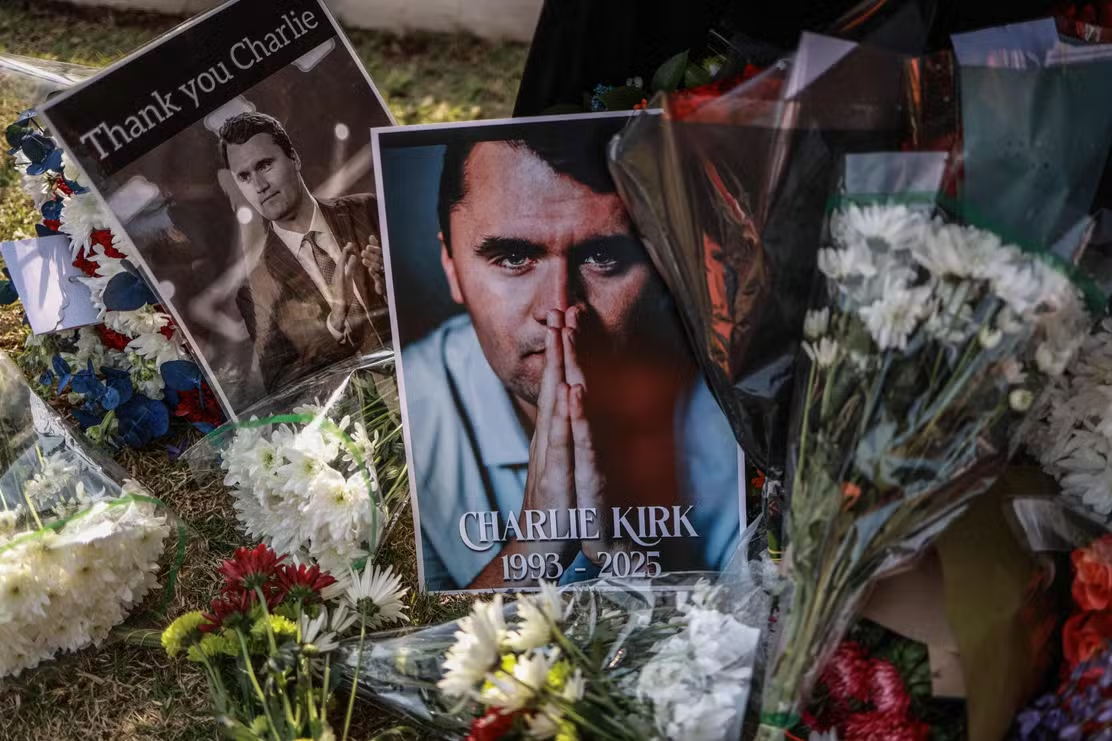
ALMATY — A single gunshot in Utah silenced one of America’s loudest conservative voices — and the echo reached all the way to Almaty.
Charlie Kirk, 30, founder of Turning Point USA, was assassinated on Sept. 10 while speaking at Utah Valley University. By morning in Kazakhstan, phones buzzed with notifications and whispers spread through KIMEP University’s campus. For many students, the incident was not just a story from faraway America. It was a reminder that ideas are not only debated in classrooms — they can carry life-or-death consequences.
Known for his defense of gun rights, traditional values, and right-wing populism, Kirk gained national attention in the United States through campus tours, media appearances, and his leadership of Turning Point USA. To supporters, he was a champion of free speech and American values. To critics, a provocateur fueling division. His death and the resultant political anger has forced students around the world to ask how dangerous words can be.
Shock, disbelief, and indifference
The initial shock spread quickly among students who follow international news.
“At first, I couldn’t believe it,” said Yersultan Mamayev, a third-year public administration student. “We talk about polarization in class, but to see it end in an assassination shows how fragile democracy can be, even in developed countries.”
Some students, however, were not surprised.
“His death was ironic,” said Aikhanim Meiramali, a finance major. “He knew what he was saying and the risks that came with it. The greater irony is that he often spoke about gun violence as if it were normal — and that’s what took his life.”
Others expressed frustration but declined to comment publicly, reflecting emotions that ranged from sympathy to detachment. Some said they felt indifferent, arguing that Kirk’s rhetoric had long divided audiences and that the violence surrounding his name felt inevitable.
Debating freedom and responsibility
Other voices on campus urged reflection rather than judgment.
“I disagreed with almost everything Kirk said, but killing him was wrong,” said Samat Adilov, a second-year journalism student. “If we start answering speeches with bullets, then nobody will feel safe to express their views.”
The incident sparked uncomfortable but important debates within KIMEP. In classrooms and cafeterias, students wondered whether universities should host polarizing speakers or whether controversial voices are exactly the ones that need to be heard.
Beyond America: why it matters to Kazakhstan
For some, the tragedy felt closer to home.
“We sometimes think that violence like this only happens in the U.S.,” said Amina Bayanova, a third-year law student. “But freedom of speech is fragile everywhere. We should learn from this and protect open dialogue in Kazakhstan before it’s too late.”
The discussion extended beyond Kirk’s politics to a broader question: how societies handle disagreement. Many students saw parallels with Kazakhstan, where debates about civic participation and dissent still carry risk.
A global echo
Internationally, reactions came quickly. Former U.S. President Donald Trump called Kirk “a legendary leader of America’s youth,” while Barack Obama condemned the act as “despicable violence.” Israeli Prime Minister Benjamin Netanyahu described Kirk as “lion-hearted.” These tributes underscored the reach of Kirk’s influence — and why his death reverberated so far from Utah, even in Almaty.
Still, the shadow of fear lingers.
“It’s difficult not to imagine something like this happening at any big campus,” Mamayev said. “We trust that KIMEP is safe, but the world feels smaller now. A gunshot in Utah echoes here in Almaty.”
The suspect in the killing, 25-year-old Tyler Robinson, has been charged with aggravated murder. Prosecutors allege he was motivated by politics, claiming he believed Kirk “spread too much hate.” For KIMEP students, that detail sparked reflection: what happens when passionate disagreement crosses the line into violence?
“Charlie Kirk was controversial, yes,” Bayanova said. “But if controversy ends in bullets, then none of us are safe to speak our minds. That’s not just America’s problem — that’s a global problem.”
Half a world away, the assassination of Charlie Kirk has left more than headlines — it has left a question hanging in the air: if democracy depends on dialogue, how do we keep the conversation alive without letting it turn deadly?